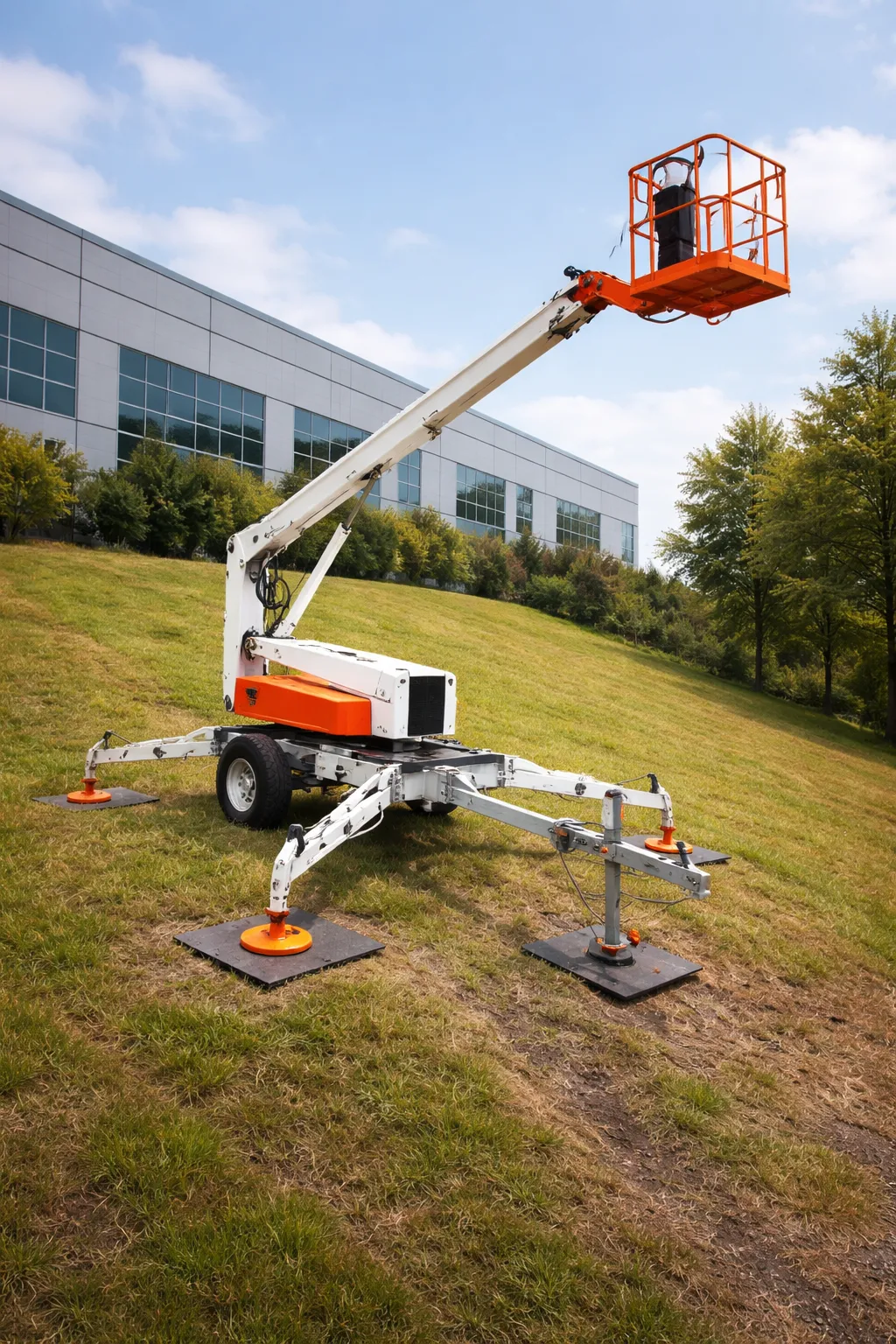
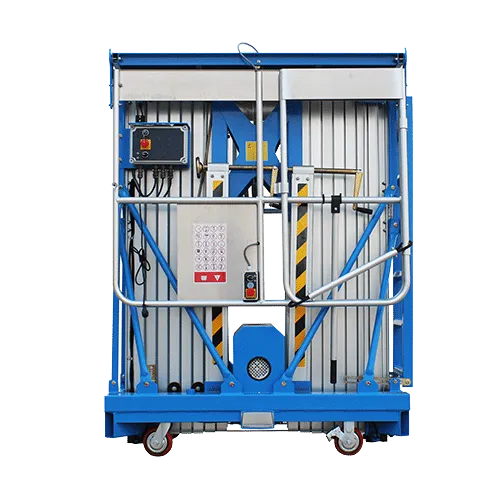
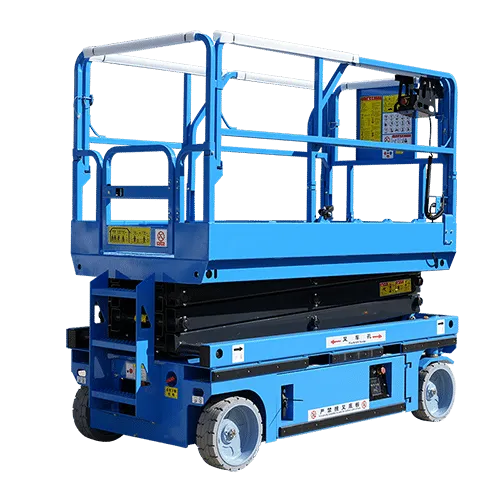
Boom lift is a type of aerial work platform designed to lift workers, tools, and materials to elevated work areas. Unlike vertical-only lifts, a boom lift provides both vertical and horizontal reach, making it suitable for jobs that require access over obstacles or in hard-to-reach locations.
Boom lifts are widely used in construction, maintenance, industrial facilities, tree care, utilities, and outdoor installation projects.
What Does a Boom Lift Do?
A boom lift uses a hydraulic arm, also called a boom, to raise and position a work platform at height.
It helps operators:
- Reach elevated areas safely
- Work over walls, roofs, machines, or other obstacles
- Position the platform accurately
- Complete high-level tasks more efficiently than ladders or scaffolding
For many work-at-height projects, boom lifts provide a safer and more flexible access solution.
Main Components of a Boom Lift
A typical boom lift includes several key parts:
Chassis
The chassis supports the machine and provides mobility. Depending on the model, it may be self-propelled, trailer-mounted, or track-mounted.
Boom Arm
The boom arm is the main lifting structure. It may be telescopic, articulated, or a combination of both.
Turntable
The turntable connects the boom to the chassis and allows the upper structure to rotate.
Work Platform
The platform, also called a basket, carries the operator, tools, and materials. Some models include a jib for more precise positioning.
Hydraulic and Control System
The hydraulic system powers lifting, extension, and rotation. Controls are usually available from both the ground and the platform.
Types of Boom Lifts
Boom lifts can be classified by structure, power source, and mobility.
1. By Structure
Telescopic Boom Lift
A telescopic boom lift, also known as a straight boom lift, uses a straight extendable arm. It provides long horizontal reach and high working height.
Best for:
- Open job sites
- Steel structure work
- High-rise building maintenance
- Long-distance access
Articulating Boom Lift
An articulating boom lift, also called a knuckle boom lift, has multiple boom sections connected by joints. It can move up, over, and around obstacles.
Best for:
- Confined spaces
- Complex building structures
- Industrial maintenance
- Areas with obstacles
2. By Power Source
| Power Type | Key Features | Best Use |
|---|---|---|
| Electric Boom Lift | Low noise, zero emissions | Indoor work, warehouses, factories |
| Diesel Boom Lift | Strong power, long runtime | Outdoor construction, rough terrain |
| Hybrid Boom Lift | Electric + diesel flexibility | Mixed indoor and outdoor projects |
Electric models are often preferred for indoor environments. Diesel models are better for outdoor and heavy-duty work. Hybrid models are suitable when both indoor and outdoor operation are required.
3. By Mobility
Towable Boom Lift
A towable boom lift is mounted on a trailer chassis and can be transported by vehicle. It is lightweight, portable, and cost-effective for light-duty access work.
Best for:
- Building maintenance
- Tree trimming
- Rental companies
- Contractors working at multiple sites
Crawler Boom Lift / Spider Lift
A crawler boom lift, also known as a spider lift, uses tracks and stabilizing outriggers. It offers strong ground adaptability and can operate on soft, uneven, or sensitive surfaces.
Best for:
- Narrow access areas
- Sloped or uneven ground
- Landscaping
- Indoor atriums and sensitive floors
Self-Propelled Boom Lift
A self-propelled boom lift is wheel-driven and can move around the job site without towing. It offers high working efficiency on large sites.
Best for:
- Construction sites
- Industrial facilities
- Frequent repositioning
- Outdoor installation work
Typical Working Height and Specifications
| Boom Lift Type | Typical Working Height | Key Advantage |
|---|---|---|
| Towable Boom Lift | 10–18 m | Portable and cost-effective |
| Articulating Boom Lift | 10–30 m+ | Flexible reach over obstacles |
| Telescopic Boom Lift | 20–50 m+ | Long reach and high height |
| Spider Lift | 12–30 m | Strong terrain adaptability |
Common specifications to consider include:
- Working height
- Horizontal outreach
- Platform capacity
- Machine width
- Power type
- Ground adaptability
Common Applications of Boom Lifts
Boom lifts are used in many industries where safe elevated access is required.
Common applications include:
- Construction and steel structure installation
- Building maintenance and facade work
- Electrical and lighting installation
- Tree trimming and landscaping
- Warehouse and industrial maintenance
- Sign installation and advertising work
- Event setup and film production
- Emergency rescue and infrastructure maintenance
Boom Lift vs Scissor Lift
Both boom lifts and scissor lifts are aerial work platforms, but they are designed for different tasks.
| Feature | Boom Lift | Scissor Lift |
|---|---|---|
| Movement | Vertical + horizontal | Vertical only |
| Reach | Can reach over obstacles | Straight up |
| Platform Size | Smaller | Larger |
| Load Capacity | Moderate | Higher |
| Best Use | Hard-to-reach areas | Stable vertical work |
Choose a boom lift when horizontal reach or obstacle access is required. Choose a scissor lift when the work area is directly above the machine and a larger platform is needed.
Advantages of Boom Lifts
Boom lifts offer several important benefits:
- Flexible access to difficult work areas
- Ability to reach over obstacles
- Faster setup compared with scaffolding
- Suitable for many indoor and outdoor jobs
- Precise positioning at height
- Improved safety compared with ladders
Limitations of Boom Lifts
Boom lifts are highly useful, but they are not suitable for every task.
Common limitations include:
- Smaller platform than scissor lifts
- Lower load capacity than some vertical lifts
- Higher purchase or rental cost
- More operator training required
- Some models require stable ground or outriggers
Understanding these limitations helps users choose the right equipment for each job.
How to Choose the Right Boom Lift
Before selecting a boom lift, consider the following factors:
1. Working Height
Choose a model that can safely reach the required height. Avoid operating constantly at the maximum rated height.
2. Horizontal Outreach
If the work area is behind an obstacle, select a model with sufficient outreach.
3. Work Environment
For indoor work, electric models are usually preferred. For outdoor or rough terrain, diesel, hybrid, crawler, or rough-terrain models may be more suitable.
4. Ground Conditions
Flat concrete, soft soil, slopes, grass, and rough terrain require different machine types.
5. Platform Capacity
Consider the total weight of operators, tools, and materials.
6. Mobility Requirements
If the machine must be moved frequently between sites, a towable boom lift may be more practical. For large job sites, a self-propelled model may improve efficiency.
Safety Tips for Boom Lift Operation
Safe operation is essential when using any aerial work platform.
Basic safety tips include:
- Inspect the machine before use
- Operate on stable ground
- Follow the rated load limit
- Wear a safety harness when required
- Keep both feet on the platform floor
- Avoid overhead power lines
- Do not operate in strong wind or severe weather
- Follow the manufacturer’s operating manual
- Ensure operators are properly trained
For towable and spider boom lifts, outriggers should be fully deployed and adjusted before lifting.
Cost and Price Factors
The cost of a boom lift depends on several factors:
- Working height
- Power type
- Structure type
- Mobility type
- Platform capacity
- Custom options
- Brand and manufacturing quality
Towable boom lifts are usually more cost-effective for light-duty work. Telescopic and large self-propelled boom lifts are generally more expensive because of their reach, power, and structure.
For long-term and frequent use, purchasing may be more economical. For temporary projects, rental may be more practical.
FAQ
What is a boom lift used for?
A boom lift is used to lift workers safely to elevated or hard-to-reach areas for construction, maintenance, installation, tree care, and industrial work.
Is a boom lift the same as a cherry picker?
In many markets, “cherry picker” is a common name for a boom lift. Boom lift is the more technical industry term.
What is the difference between a boom lift and a scissor lift?
A boom lift can move both vertically and horizontally, while a scissor lift only moves vertically. Boom lifts are better for reaching over obstacles. Scissor lifts provide larger platforms and higher load capacity.
Can a boom lift be used indoors?
Yes. Electric boom lifts are suitable for indoor use because they produce no emissions and operate with low noise.
How high can a boom lift reach?
Working height depends on the model. Towable boom lifts commonly reach 10–18 m, while larger telescopic boom lifts can reach 50 m or more.
Do boom lifts need stable ground?
Yes. Boom lifts should be used on stable ground. Some models, such as crawler boom lifts or towable boom lifts with outriggers, can adapt to limited uneven surfaces, but the machine must be properly leveled before operation.
Conclusion
A boom lift is a flexible and efficient solution for working at height. Its ability to provide both vertical and horizontal reach makes it suitable for construction, maintenance, industrial work, tree care, and many other applications.
Different boom lift types serve different needs:
- Telescopic boom lifts are best for long reach and high access.
- Articulating boom lifts are best for working around obstacles.
- Towable boom lifts are portable and cost-effective.
- Spider lifts are suitable for narrow access and uneven ground.
- Self-propelled boom lifts improve efficiency on large job sites.
LEMAX provides a range of aerial work platforms, including towable boom lifts, spider lifts, scissor lifts, and mast lifts. With lightweight design, customizable configurations, and factory-direct supply, LEMAX equipment can meet different work-at-height requirements.
Need help choosing the right boom lift? Contact LEMAX for a model recommendation based on your project needs.